
About the book
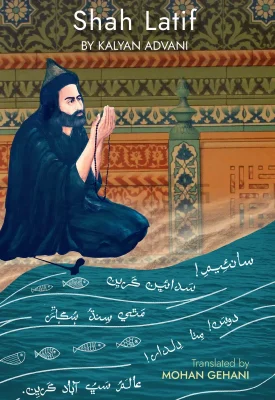
Shah Abdul Latif Bhittai: A voice beyond borders In the songs of wandering minstrels, the defiance of women who refused to yield, and the passion of lovers who braved the world, the soul of Sindh found its truest voice – Shah Abdul Latif Bhittai. His verses wove together Sufi and Vedantic wisdom, folk legend and spiritual metaphor, in poetry that has remained luminous for centuries. For generations of Sindhis, Shah’s poetry was sacred ground – a compass, a comfort, a call to truth. Partition brought deep ruptures. Those exiled from Sindh and scattered across the world lost not only their homeland but the living culture that had shaped their every word, song, and celebration; those who remained saw their traditions colonised and their ties to the departed painfully severed. This book is offered as a bridge – and perhaps a salve – for all who carry the enduring ache of separation. It offers a contemporary English telling of Shah’s life and poetry for readers who may no longer speak the language of their ancestors, yet seek to reclaim the heritage that was torn from them. Together, the three volumes of this trilogy offer a path back to the spiritual heart of Sindh – through the voices of Shah, Sachal, and Sami – whose words, once carried in song and story, can now speak again to generations that were never meant to forget.
About Kalyan Advani
Kalyan Bulchand Advani (1911-1994) studied at Government High School and DG National College, Hyderabad, Sindh. A writer from an early age, he earned a Bombay University MA in English and Persian, and was appointed professor at his old college and Head of the Sindhi Department in 1942. In 1946, he received an award from the Sindh government for his translation of Kalidasa’s masterpiece Shakuntala. This translation was later prescribed as a textbook for degree examinations.
After Partition, he joined Jai Hind College as a professor of English and Persian and, with high teaching ideals, and time and courtesy for his students, he was much loved.
Kalyan Advani authored books on the medieval Sufi poets of Sindh: Shah (1951) Sami (1953) and Sachal (1954). A scholar of the highest order, in these books he shared knowledge about the great Sindhi poets, who number among the most respected mystical poets of the world.
Raaz o Niyaaz (1960) is a collection of his own poetry. In 1968, he received the Sahitya Akademi Award for his Shah jo Risaalo Mujamal (1966), a critically annotated abridgement of Shah jo Risaalo.
His works in English include monographs on Shah Latif and Sachal Sarmast published by Sahitya Akademi, issued in 1970 and 1971, and Qalam (1987). This collection of poems is in almost all poetic forms and philosophic formulations.
Shah jo Risaalo Mujamal is seen as his magnum opus. When Nandita Bhavnani visited Sindh in 2001, she learnt that it was still considered the most comprehensive work on the subject.